Customized Spanish lessons for English speakers

Why Can the Letter X Be Unusual in Mexican Spanish?
The letter X in Spanish is pronounced much like it is in many other languages. It is usually pronounced as the combination of two sounds: K and S (/ks/ in the International Phonetic Alphabet [IPA]). This occurs in words such as boxeo (“boxing”), exacto (“exact”), and laxante (“laxative”). This pronunciation is found in all varieties of Spanish and generally causes no difficulties. In any Spanish-speaking country, the letter X has this pronunciation.
6/1/20263 min read
Why Can the Letter X Be Unusual in Mexican Spanish?
The letter X in Spanish is pronounced much like it is in many other languages. It is usually pronounced as the combination of two sounds: K and S (/ks/ in the International Phonetic Alphabet [IPA]). This occurs in words such as boxeo (“boxing”), exacto (“exact”), and laxante (“laxative”). This pronunciation is found in all varieties of Spanish and generally causes no difficulties. In any Spanish-speaking country, the letter X has this pronunciation.
However, in Mexican Spanish, the letter X sometimes has different pronunciations in words that are specific to the country.
To begin with, this is noticeable in the name of the country itself. México is well known for having a particular pronunciation in Spanish. It can be represented as “Meh-hee-koh” using an English-based spelling approach. All Spanish-speaking countries use this pronunciation, although many speakers do not know why it is pronounced this way.
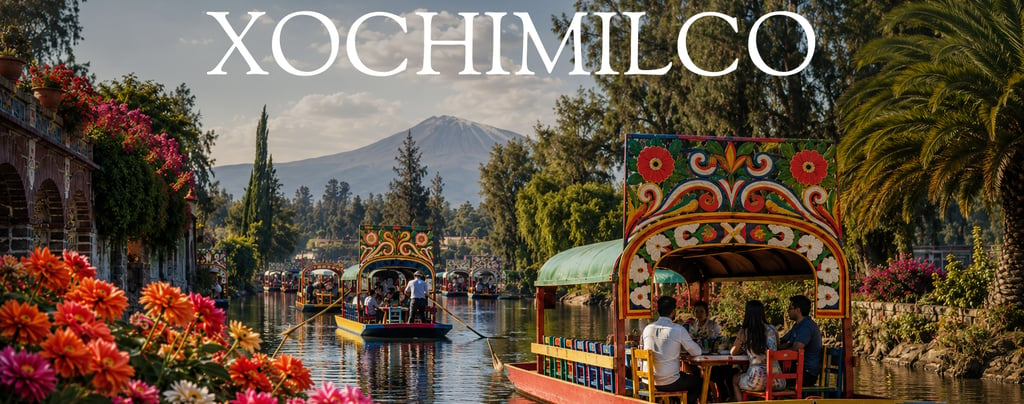
On the other hand, if you travel throughout Mexico, especially in the central and southern parts, you will find regions, cities, and towns whose names contain the letter X. One example is the state of Oaxaca, considered the ideal food tourism hub. Another is a district in Mexico City, often called the “Mexican Venice,” known as Xochimilco. Finally, there is an archaeological site featuring ancient pyramids and an ecotourism amusement park near Cancún called Xcaret. However, in none of these three names is the letter X pronounced the same way.
In Oaxaca, the X shares the same pronunciation as in México, the sound often represented by the letter H in English spellings or by the letter J in Spanish (actually /x/ in IPA). In Xochimilco, by contrast, it is pronounced like the Spanish letter S (/s/ in IPA). Finally, when it comes to Xcaret, it is pronounced like the English “sh” sound (/ʃ/ in IPA). Why does this happen?
When the Spanish conquerors arrived in the Americas and colonized the region, they brought with them the educated scholars of the time: members of religious orders, friars, and priests. These men were the intellectuals of their era, and part of their work involved studying Indigenous languages so they could communicate with them as a first step and evangelize them as the second step. Through their research, they encountered sounds and distinctions that could not easily be represented using the Spanish alphabet as they knew it. At that time, Spanish commonly used the letter X to represent a sound similar to what we now pronounce as “sh.” As they encountered similar and different sounds in the languages of Mexico, they developed adaptations, assigning new functions to letters of the Spanish alphabet in order to represent Indigenous languages.
Nahuatl, the language of the Aztecs, was the most widespread language in what is now Mexico, and its many varieties included a sound that these scholars —whom we would now call linguists— chose to represent in the Latin alphabet, the one we still use, using the letter X.
But just as the Nahuatl spoken at that time is not identical to modern Nahuatl, Spanish also evolved over the centuries. The “sh” sound became much less common and was often replaced by the sound represented by the letter J. This change affected many words of Aztec origin, such as México, Oaxaca, and Mexicali, where the letter X came to be pronounced like a spanish J. However, the change did not affect all words of Aztec origin. Some retained the “sh” pronunciation, such as Xola and Mixiuhca, while others shifted in a different direction and came to be pronounced with an S sound, such as Xochimilco and Xóchitl.
Today, there are a little over one and a half million speakers of Nahuatl in Mexico. The language has had a strong influence on the Spanish spoken in the country, as well as an international impact —words such as tomato, avocado, chocolate, and cocoa ultimately come from Nahuatl—. However, its most visible presence is found in the names of many towns, cities, and regions of Mexico, as well as in the names of certain foods and animals. For all of these reasons, the pronunciation of the letter X varies greatly depending on the word, and Mexico has preserved this pronunciation in its official name as a symbol of identity and connection to its origins.
As a Spanish learner, you need to take this into consideration when traveling throughout the country. It’s not a huge issue that might hinder your understanding of this variety of Spanish at all: think about it as something that, if well studied, could improve your experience when traveling and eating and could help you avoid a couple of misunderstandings.